
What You’ll Learn
- What identity-driven marketing actually is — and why it’s now foundational, not optional
- How identity connects fragmented data across devices, channels, and environments
- How brands use identity to improve relevance, efficiency, and measurement in a cookieless world
Who This Guide Is For
- You’re a marketing or media leader navigating cookieless, privacy‑first environments and need a clear, shared understanding of how identity fits into modern advertising strategy.
- You’re an agency or performance marketer responsible for activating audiences across multiple platforms, DSPs, and environments, and struggling with fragmentation, duplication, or limited audience visibility.
- You’re a data‑driven organization with strong first‑party signals, but no reliable way to connect, activate, and measure them across devices and channels.
Marketers love to say they’re data-driven.
And sure — dashboards are packed, charts are polished, and the acronyms keep multiplying.
But the problem no one loves talking about? Having data isn’t the same as knowing who you’re actually talking to.
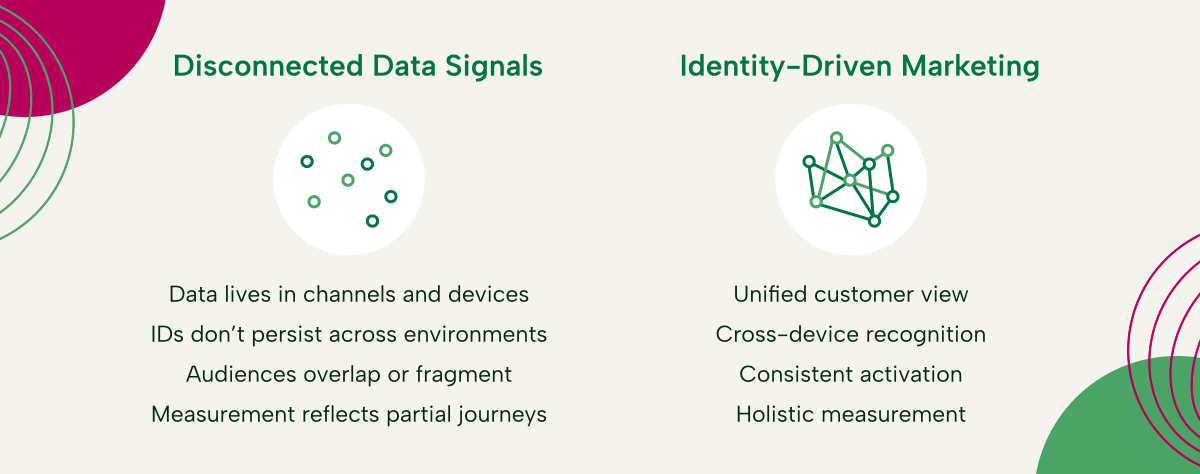
As third-party cookies disappear and privacy expectations rise, many brands are discovering that their data doesn’t travel very well anymore. Signals are fragmented. Audiences don’t line up. Measurement gets fuzzy. And suddenly, “personalization” starts to look a lot like educated guessing.
This is where identity driven marketing comes in — not as another tactic, but as the infrastructure modern marketing actually runs on.
What Is Identity Driven Marketing (Really)?
At its core, identity driven marketing is about connecting the dots — across devices, channels, and moments — so marketers can recognize real customers, not just isolated interactions.
Instead of relying on anonymous cookies or channel-specific IDs, identity based marketing brings together:
- First-party customer data
- Authenticated signals like hashed emails or logins
- Behavioral and contextual insights
- Probabilistic modeling to responsibly extend reach
The goal isn’t more data.
It’s a unified identity spine — one that lets you understand how someone moves from browsing to buying, from app to site, from curiosity to conversion.
Traditional data-driven marketing tells you what happened.
Identity-driven marketing tells you who did it, across where, and why it matters.
Why Identity Matters More Than Ever
This shift isn’t theoretical — it’s already happening.
According to industry research, over 90% of advertisers, publishers, and ad tech providers are actively looking beyond third-party cookies to alternative identity solutions, signaling broad agreement that cookie-based targeting is no longer sustainable.
At the same time, consumers are increasingly limiting tracking at the browser level. Estimates show that a majority of users have restricted or disabled third-party tracking, shrinking the addressable cookie-based web in real time.
Translation:
Cookies aren’t “going away someday.” They’re already unreliable — and identity has to fill the gap.
For expert perspective on why the roadmap keeps shifting, read Google’s cookie U‑turn: what it means for advertisers.
Without identity, data still exists, but activation breaks down. Audiences can’t be recognized across environments. Frequency control collapses. Measurement turns into approximation.
Identity enables activation where cookies can’t — in cookieless browsers, mobile apps, CTV environments, and authenticated publisher ecosystems.
What Breaks When Identity is Missing
When identity is missing, even strong strategies quietly lose value.
You Lose Visibility
Returning customers look like new ones. Cross-device behavior stays disconnected. Valuable signals never connect.
Personalization Stalls
Without real-time identity resolution, personalization becomes generic — and generic doesn’t convert.
Media Waste Creeps In
Disconnected identifiers drive inefficiency. Identity resolution technologies can reduce cross-device data loss by roughly 30–35%, helping marketers deduplicate audiences and improve reach accuracy.
Measurement Becomes Guesswork
Attribution breaks down when identifiers don’t connect — masking what’s actually driving performance.
In short: data without identity creates blind spots.
And blind spots are expensive.
Identity Is What Holds the Customer Journey Together
Identity driven marketing works because it connects signals across the full lifecycle:
- Awareness
- Discovery
- Consideration
- Conversion
- Retention
Instead of optimizing each channel in isolation, identity lets marketers see how everything connects, and act accordingly.
That means:
- Audiences can be activated consistently across environments
- Audience visibility stays intact across channels
- Frequency is easier to control, reducing duplication and waste
Identity doesn’t just connect data.
It connects decisions.
How Identity Resolution Powers Identity-Driven Marketing
Identity driven marketing only works if identities can actually be recognized, resolved, and activated — consistently and at scale. That’s where identity resolution comes in.
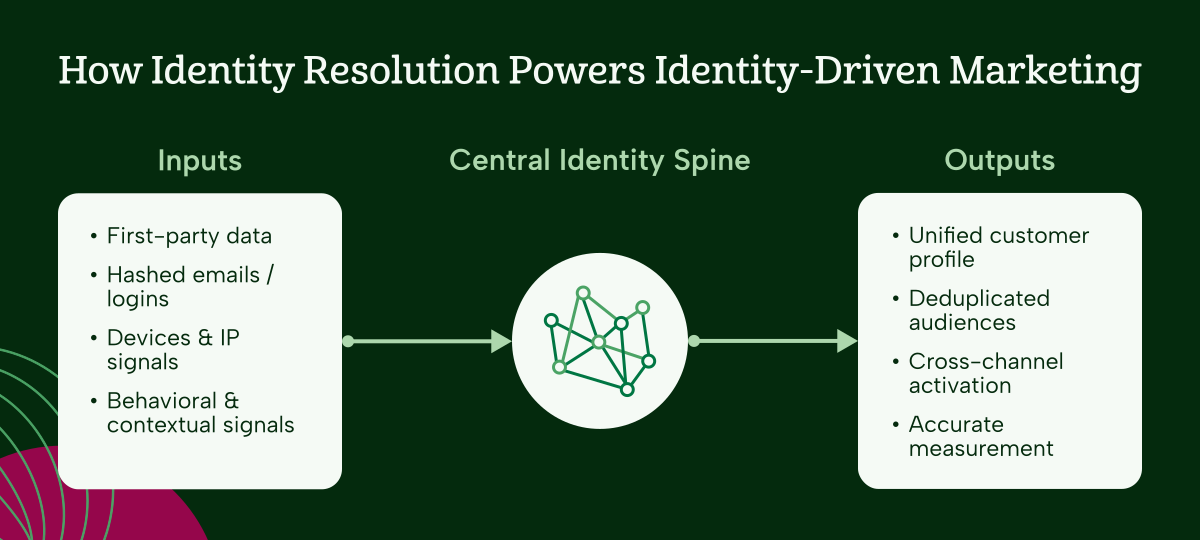
Identity resolution is the process of connecting fragmented signals — across devices, browsers, channels, and environments — into a single, privacy-safe view of the consumer. It links deterministic signals (like hashed emails or authenticated logins) with probabilistic signals (like behavioral and contextual patterns) to create a more complete, durable identity.
If you’re new to the concept, start here: Back to basics: what is identity resolution?
In practice, this means marketers can:
- Recognize the same audience across web, mobile, CTV, and authenticated environments
- Deduplicate audiences to reduce wasted impressions
- Activate consistent messaging across channels
Identity resolution isn’t a one-time match — it’s an ongoing process that updates as consumers move, browse, and engage. And when it’s built into your marketing infrastructure, identity-driven strategies become far more scalable and reliable.
To go deeper on how identity resolution and activation work in practice, explore Lotame’s Identity Resolution & Activation capabilities.
From Identity Resolution to Connected Data Marketing
Modern marketers aren’t short on data — they’re short on clarity.
Disconnected platforms, siloed teams, and stale signals make it hard to respond to how consumers actually behave, especially in periods of economic pressure. As cost-of-living pressures reshape priorities, assumptions age fast.
Connected data marketing brings identity, first-party signals, and collaboration into a single framework — allowing brands to adapt in real time, not months later.
Identity-Driven Marketing Examples: Targeting with Precision
Identity based marketing replaces broad assumptions with real insight — specifically, insight into why your ideal customers are in-market, not just that they are.
Example 1: Energy Provider Messaging
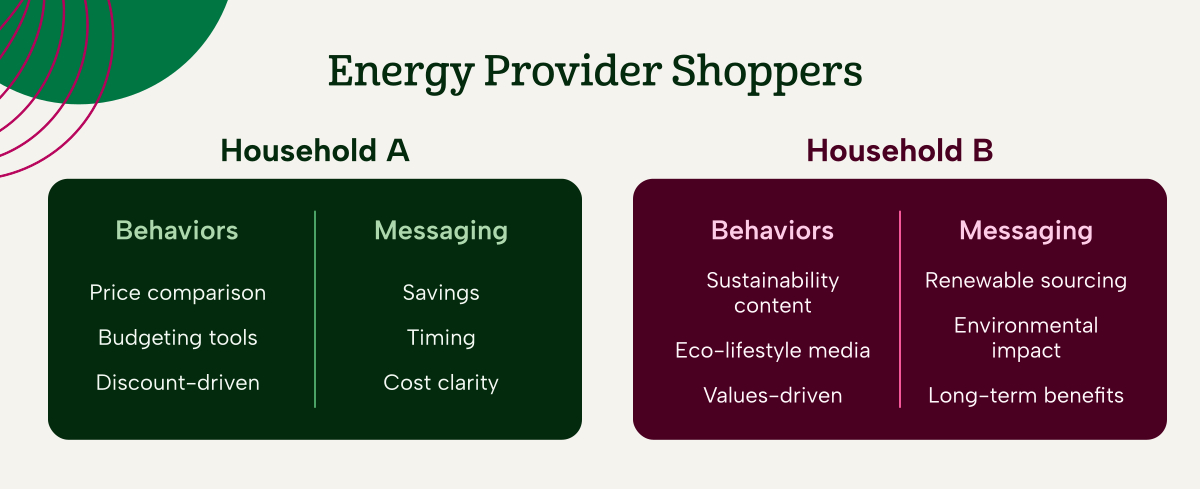
Consider two households researching a new energy provider:
Household A
- Regularly visits price-comparison sites
- Uses budgeting and savings tools
- Engages with content focused on lowering monthly costs
What this behavior signals:
This household is price-sensitive and timing-driven. They’re likely to respond to clear cost comparisons, discounts, or limited-time offers.
Household B
- Consumes sustainability and eco-lifestyle content
- Filters energy plans by environmental impact
- Engages with long-term, values-based decision content
What this behavior signals:
This household is values-driven, not price-first. Messaging focused on renewable energy sources or environmental impact is far more persuasive.
Same product category. Completely different motivations.
Without identity, both households receive the same generic “switch providers” message — and relevance suffers. With identity, messaging aligns with motivation. And motivation is where performance lives.
Example 2: Retail & Ecommerce Personalization
Two shoppers visit the same retail site in the same week.
Shopper A
- Frequently browses sale sections
- Clicks on promotional emails
- Abandons carts when prices fluctuate
What this behavior signals:
High price sensitivity. Promotional messaging, retargeting with discounts, and urgency-based creative are more likely to convert.
Shopper B
- Browses new arrivals and premium collections
- Engages with brand storytelling and product reviews
- Returns to the site across multiple devices
What this behavior signals:
Brand-led decision-making. Messaging that emphasizes quality, exclusivity, or brand values performs better than discounts.
Identity allows retailers to recognize these shoppers across sessions and devices — and tailor experiences accordingly.
Example 3: CTV & Cross-Channel Activation
A streaming viewer watches content across multiple devices but isn’t logged in everywhere.
With identity resolution:
- Their CTV exposure can be connected to later mobile or web engagement
- Frequency can be controlled across screens
- Sequential messaging can be applied (awareness → consideration → action)
Without identity, each exposure is treated as a new person. With identity, the experience feels intentional — not repetitive.
Example 4: B2B & Long Consideration Cycles
In B2B environments, identity driven marketing helps connect:
- Anonymous research behavior
- Repeat visits from different devices
- Engagement with thought leadership content
Identity resolution allows marketers to recognize buying signals earlier, align sales and marketing insights, and activate relevant messaging long before a form fill ever happens.
Identity also surfaces non-obvious media behaviors — revealing where these audiences actually spend time beyond the channels marketers typically expect. Those overlooked environments are often where efficiency and incremental reach come from.
Scaling Reach Without Guessing: Probabilistic Intelligence
Not every consumer logs in. Not everyone opts in. That doesn’t mean they’re unreachable.
Probabilistic modeling allows platforms to analyze behavioral patterns and responsibly identify new audiences that resemble known users — extending reach without relying on deprecated identifiers.
Importantly, probabilistic intelligence doesn’t replace deterministic identity. Deterministic signals provide accuracy and trust where they exist. Probabilistic approaches extend that foundation, filling in gaps where direct identifiers aren’t available, and allowing identity‑driven strategies to scale across environments.
It’s not spray-and-pray scale.
It’s informed expansion.
Learn how this fits into a modern identity strategy in Mastering identity resolution strategy.
Data Collaboration: Smarter Partnerships, Fewer Silos
Identity- driven marketing gets even more powerful when data collaboration enters the picture.
Secure collaboration environments allow brands, publishers, and partners to align audiences and insights without giving up control of their data — a necessity in today’s privacy-first environment.
This approach supports safer data sharing, better targeting, and stronger performance — especially when resources are limited.
For a practical agency‑led view, see The agency data strategist guide to identity, clean rooms, and collaboration.
Why Identity Wins When Budgets Don’t
Economic pressure doesn’t just test budgets — it tests efficiency.
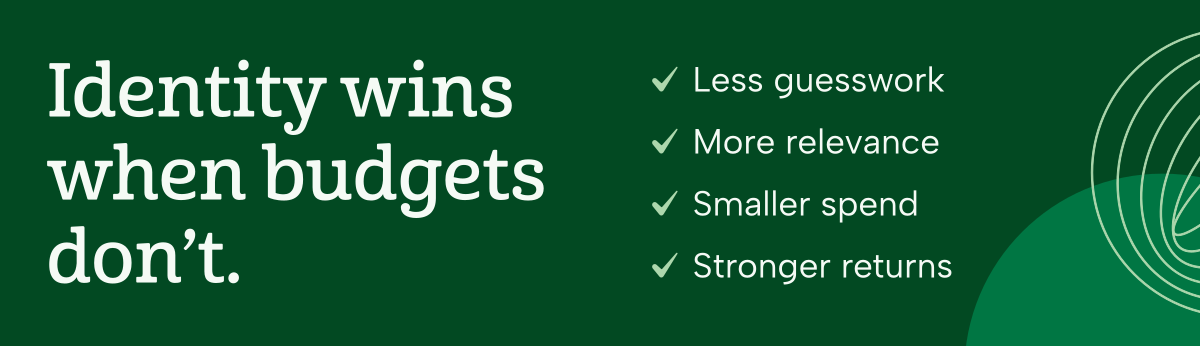
Disconnected data forces overreach and overspend. Identity driven marketing flips the equation:
- Less guesswork
- More relevance
- Smaller spend
- Stronger returns
It’s not about adding more tools.
It’s about making what you already have work harder.
Final Thought: Identity Isn’t Optional Anymore
Identity-driven marketing isn’t a trend — it’s a correction.
Brands that lead today are the ones that can:
- Unify first-party data
- Resolve identities responsibly
- Activate audiences in cookieless environments
- Measure performance with confidence
At Lotame, a division of Publicis Groupe and Epsilon, identity isn’t an add on feature — it’s our foundation. Our centralized identity spine is built into our platform and audience solutions, making data connected, actionable, and secure from the start. Through the Spherical platform, brands can make sense of the data they already have, enrich it with the data they need, and activate audiences with accuracy and scale — even as the advertising ecosystem continues to evolve.
The tools exist. The approach works.
The only question is whether identity is already part of your strategy — or still something you’re circling around. When you’re ready to make it foundational, we’re here to talk.
About the Author