
What You’ll Learn
- What data connectivity actually means in advertising, beyond integrations and point solutions
- Why strong audience strategies break down at activation without connectivity
- How connectivity affects portability across DSPs, partners, and environments
- What connected data changes compared to siloed data in real workflows
- How to design audience activation so strategy holds as platforms and environments change
Who This Guide Is For
- You are a marketer or agency leader responsible for activating audiences across multiple platforms and DSPs, and want to reduce rebuilds, delays, and fragmentation.
- You manage audience strategy or activation and need a clearer way to make identity and data usable across environments so audiences can move with you, not stay trapped in a single system.
- You work across partners, publishers, or clean rooms and need connectivity that supports scale without forcing new workflows for every destination.
Activation is where fragmentation shows up fastest.
Marketers and agencies operate in a multi‑platform reality. Audiences are defined in one place, activated in another, and constrained by integrations that do not always align.
Without connectivity, strategy breaks down. Segments get rebuilt. Activation timelines stretch. Scale becomes harder than it should be.
Data connectivity helps solves this. It provides the infrastructure that allows audiences to move across DSPs, partners, and environments without losing fidelity.
This guide breaks down how data connectivity works in advertising, where it breaks down in practice, and how marketers can activate audiences across a fragmented ecosystem with confidence.
What Data Connectivity Actually Means in Advertising
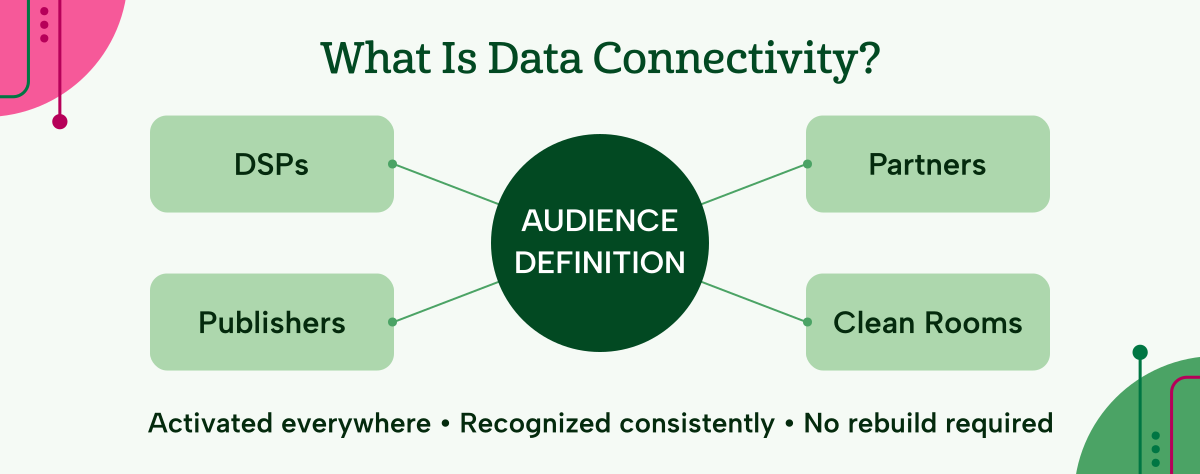
Data connectivity is the ability for audience data to move consistently across platforms, partners, and activation environments.
It ensures audiences defined in one place can be recognized and used wherever activation happens.
In practice, connectivity strongly influences:
- Where audiences can be activated
- If they need to be rebuilt
- Whether strategy survives platform and ecosystem change
While much of the industry has focused on cookieless tactics, today, the real challenge is broader. Identity without connectivity can still leave audiences trapped in silos.
Why Good Audiences Fail Without Connectivity
Many audience strategies fail after they are built.
Teams define strong audiences using meaningful signals and clear intent. Then those audiences hit activation. Platforms differ. DSP requirements vary. Integrations do not align.
Without connectivity, audiences must be rebuilt for each destination. That introduces delay, duplication, and loss of confidence. Strategy becomes fragmented by channel instead of guided by intent.
As we explored in Your Ads Are Only as Good as Your Audience Activation, performance depends on where and how audiences can actually be used. Connectivity is what closes the gap between planning and execution.
The Programmatic Ecosystem and the Role of DSPs
Audience activation happens inside the programmatic ecosystem.
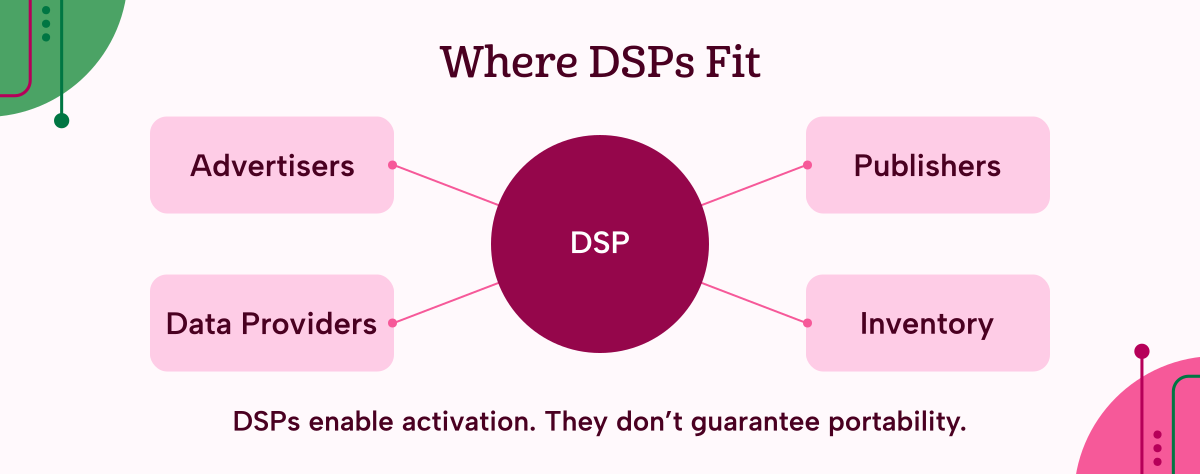
DSPs play a central role in buying, targeting, and scaling media. They determine where demand meets supply and how audiences are applied across inventory.
Understanding how DSPs fit into the ecosystem matters, especially as teams work across multiple platforms. If you need a refresher, Programmatic Ecosystem: What Is a DSP? explains the role DSPs play in modern advertising stacks.
What DSPs do not solve on their own is audience portability. Connectivity plays a key role in whether audiences can move across DSPs without being rebuilt every time.
Connected Data Marketing in Practice
Insight: Connectivity becomes critical when consumer behavior changes quickly.
In periods of economic pressure, media habits shift. Purchase cycles compress or extend. Assumptions age fast.
As shown in Connected Data Marketing: How Brands Navigate Consumer Behavior in the Cost of Living Crisis, connected data allows marketers to respond faster because signals can move across environments with less friction.
Disconnected stacks slow reaction time. Connected data supports resilience.
Partner Connectivity and Integrations
Modern activation depends on where audiences can actually be used.
No single platform covers every environment. Activation spans DSPs, publishers, clean rooms, and partners. Connectivity determines whether those pieces work together or remain isolated.
For most teams, the question is practical: Will this work with the platforms they already rely on?
For Lotame, connectivity is demonstrated through interoperability. Rather than relying on a closed ecosystem, Lotame integrates with a broad set of partners, enabling audiences to flow more easily across the platforms that support real-world buying and selling workflows.
Connectivity is not about a single integration. It is about having enough of the right connections to support scale without forcing teams to rebuild strategy for each destination.
Connected Data vs. Siloed Data: The Performance Gap
When data is siloed, activation slows long before performance does.
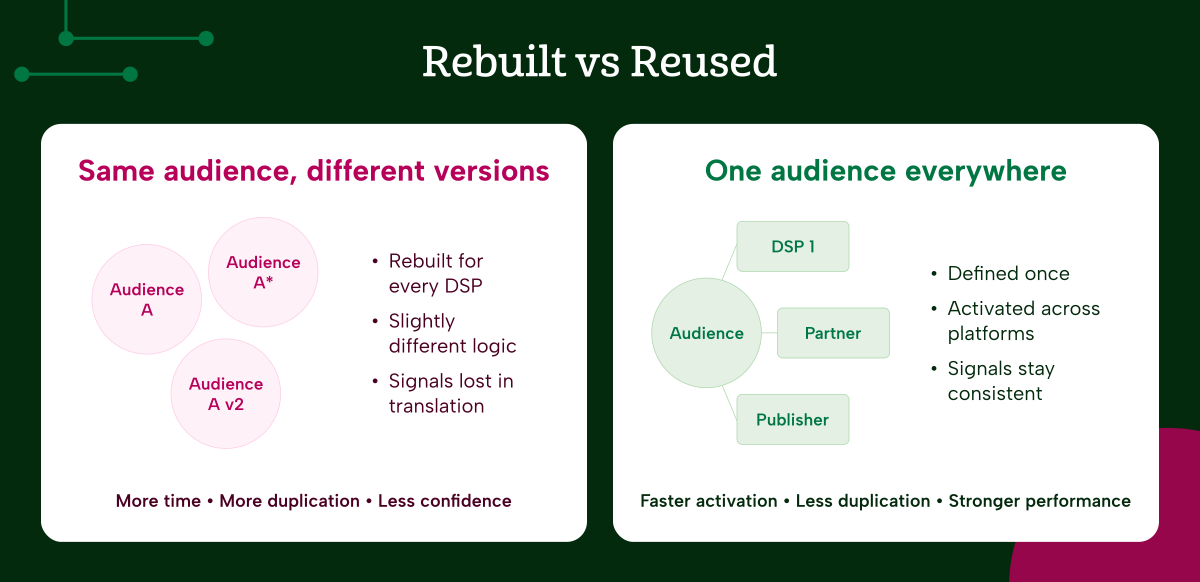
Audiences are often defined inside individual platforms or teams. One version lives in a DSP. Another lives in a CRM. A third lives inside a publisher or clean room. Each audience may be valid on its own, but none are connected.
In this model:
- Audiences are rebuilt for each platform
- Signals cannot be reused across environments
- Strategy fragments by channel instead of scaling across it
Teams spend time recreating work rather than extending it. Over time, inefficiency compounds.
Connected data changes how audiences behave.
With connectivity in place, audience definitions are not tied to a single platform. Signals move across environments, and activation no longer requires starting from scratch each time a channel or partner changes.
In practice, this means:
- Audiences remain portable across DSPs and environments
- Activation happens faster because definitions persist
- Strategy holds together as execution scales
The gap widens over time. Siloed data adds friction and cost. Connected data adds momentum and resilience.
How to Activate Audiences Across Any DSP
Audience portability has become a baseline requirement.
Most marketers and agencies operate across multiple DSPs by necessity. Different platforms support different inventory, formats, and regions. Activation rarely happens in one place.
Without connectivity, this creates immediate friction.
Audiences are often built inside a single DSP or data environment. When teams need to activate elsewhere, those audiences are rebuilt using slightly different logic, signals, or constraints. Over time, one strategy turns into multiple, inconsistent versions of itself.
Connectivity changes how activation works.
With connectivity in place, audience definitions are not tied to a single DSP. Signals can persist as activation environments change. Teams can extend the same audience logic across platforms instead of recreating it from scratch.
What this looks like in practice
Teams that activate audiences across DSPs successfully tend to focus on a few core principles:
- Define audiences upstream. Build audience logic in systems designed for reuse, not inside individual DSPs.
- Design for portability. Ensure audience definitions can move across platforms without being rewritten or degraded.
- Evaluate DSPs as destinations, not owners. DSPs are execution environments. They should not dictate how audiences are defined.
- Pressure‑test activation early. Validate where audiences can and cannot be activated before strategy is finalized.
- Plan for change. Assume platforms, partners, and inventory mix will evolve. Connectivity should absorb that change, not break under it.
This does not mean every DSP works the same way. Execution paths still vary. Inventory differs. Controls change. Connectivity helps ensure the underlying strategy remains intact even as those details shift.
Activating audiences across any DSP is not about ignoring platform differences. It is about designing audience strategy so it can travel despite them.
How Connectivity Completes Identity and Data
Identity provides continuity. Data provides signals. Connectivity makes activation possible across environments.
Without connectivity, identity is harder to activiate and data tends to remain local. Together, these pillars allow audience strategy to survive platform change and ecosystem evolution.
How Lotame Approaches Connectivity
After years of working across brands, agencies, publishers, and platforms, one lesson is consistent.
Connectivity must be designed for change.
Lotame approaches connectivity through broad integrations, interoperable infrastructure, and portability across environments. The focus is not on forcing workflows, but on enabling audiences to move where activation happens.
Final thought
Audience strategy only works if it can travel.
Connectivity is what allows identity and data to deliver value at scale in real-world activation. Without it, even the strongest audiences remain trapped.
Explore how 20 years of solving hard activation problems shape Lotame’s approach to connectivity across the advertising ecosystem.
About the Author