
You’ve heard of CTV advertising. You’ve also heard the term OTT advertising thrown around. As an “up with the times” marketer, you know streaming platforms continue to gain momentum (even surpassing cable TV viewership according to Nielsen). But you might be a bit confused about why the terms CTV and OTT advertising are used interchangeably.
Though similar, CTV and OTT advertising have distinct meanings and implications. Stick with us and we’ll explain the distinctions between the two, why it’s important to know, and how CTV and OTT advertising can play an important role in your business’ customer acquisition strategy.
Primer on OTT Ads
OTT ads are video ads delivered through streaming services that sit “on top of” traditional cable and broadcast infrastructure. These ads appear within content viewed on mobile devices, tablets, laptops, and Connected TVs, making OTT a broad category that captures any internet-delivered video experience outside a cable subscription. What sets OTT apart is its flexibility: brands can reach cord-cutters and cord-nevers at scale while applying the same granular targeting and measurement they expect from digital campaigns.
For marketers, OTT offers the best of both worlds. It delivers premium, full-screen video experiences with high completion rates, while still allowing sophisticated audience segmentation, frequency control, and cross-device attribution. Because viewers access OTT content through dozens of apps and devices, campaigns can be designed to follow the user—not the channel—creating more cohesive journeys and stronger performance outcomes. As consumer streaming habits continue to grow, OTT has become an essential complement to CTV and online video in any modern media mix.
OTT Ad Platforms
OTT ad platforms are the technology layers that connect streaming video inventory with advertisers, enabling campaigns to run across mobile apps, streaming services, desktop environments, and Connected TV devices. These platforms manage everything from audience targeting and ad delivery to pacing, frequency, and reporting. Because OTT spans dozens of publishers and devices, advertisers often rely on these platforms to unify buying and ensure campaigns reach the right viewers wherever they’re streaming.
Most OTT buying happens through a mix of publisher-owned platforms and demand-side platforms (DSPs). Hulu, Paramount+, Peacock, Discovery+, and AMC+ all offer direct OTT inventory with high-quality programming and predictable environments. On the aggregation side, DSPs like The Trade Desk, Google DV360, Yahoo DSP, and Amazon Advertising providecross-publisher access and more centralized control over targeting, budgets, and measurement. Many of these platforms also layer in household-level data, brand safety controls, and frequency management to reduce waste and improve campaign performance.
As OTT consumption continues to rise across devices, these platforms play a critical role in helping advertisers scale reach, maintain transparency, and optimize results in a fragmented streaming landscape.
Primer on CTV Ads
CTV advertising refers to video ads delivered through internet-connected televisions—smart TVs, streaming devices like Roku or Fire TV, or gaming consoles where viewers access apps such as Hulu, YouTube, and Peacock. Unlike traditional linear television, CTV allows advertisers to apply digital-style targeting and measurement to the biggest screen in the home. Campaigns can reach specific audience segments, control household frequency, and track downstream actions, making CTV one of the most precise ways to buy TV inventory.
CTV stands out because it blends the premium experience of long-form, lean-back viewing with the accountability of digital channels. Ads run in full-screen formats that command attention and achieve high completion rates, while device-level data helps ensure media is delivered efficiently with minimal waste. As more households shift to streaming-first habits, CTV has become a central component in modern media strategies, offering scale, transparency, and measurable performance that traditional TV could never support.
CTV Ad Platforms
CTV ad platforms are the systems that enable advertisers to reach viewers watching streamed content on television screens through smart TVs, streaming boxes, and gaming consoles. These platforms sit at the heart of modern CTV buying, helping marketers access premium inventory, layer on audience targeting, manage household-level frequency, and track performance across devices. Because CTV operates in a fragmented environment with dozens of apps and device manufacturers, these platforms provide the consistency and control needed to run campaigns efficiently at scale.
The ecosystem includes both device-based platforms and cross-publisher buying platforms. Roku, Amazon Fire TV, Samsung Ads, Vizio Ads, and LG Ads give advertisers direct access to massive built-in audiences, device-level viewing data, and unique ad placements in home screens and content menus. On the demand-side, platforms like The Trade Desk, Google DV360, Yahoo DSP, and Amobee centralize CTV inventory across thousands of publishers, allowing advertisers to unify targeting, bidding, pacing, and reporting within one system. Many of these platforms also incorporate first-party data onboarding, automated optimizations, and advanced attribution models to ensure CTV campaigns drive measurable business outcomes.
What’s the difference between CTV and OTT?
Let’s unravel the terminology.
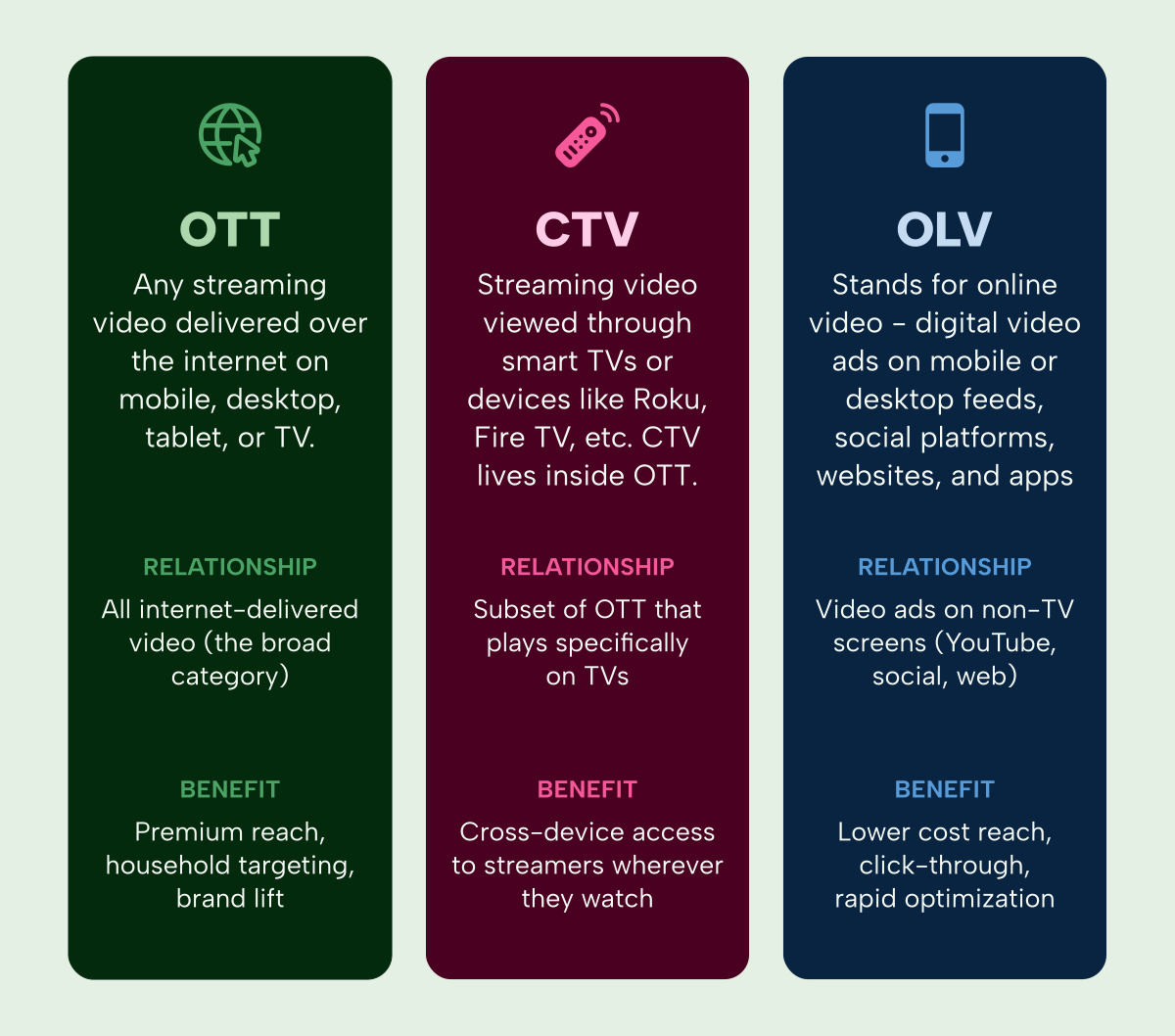
Over-The-Top (OTT): refers to the digital content, such as music or video, delivered directly to viewers over the Internet, bypassing traditional distribution channels like cable or satellite providers.
Typically when we say ‘OTT’ we are referring to OTT platforms or publishers who provide the streaming content across OTT-enabled channels. OTT publishers offer a wide array of streaming services, and some OTT advertising examples include subscription video-on-demand (SVOD), ad-supported video-on-demand (AVOD), and transactional video-on-demand (TVOD) across a multitude of devices such as web, mobile, and CTV. Examples of popular OTT streaming services include Netflix, Hulu, Amazon Prime Video, and Disney+.
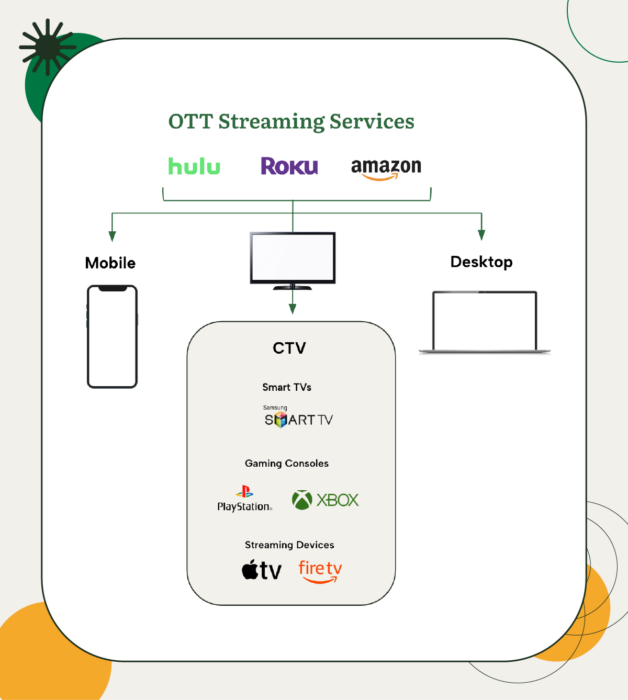
Connected TV (CTV): refers to the device itself on which you’re accessing streamed video content. Some examples of CTV devices are smart televisions (like LG or Samsung), streaming sticks (like Roku, Apple TV, Amazon Fire TV, or Google Chromecast), gaming consoles (like Xbox or Playstation), and some set-top boxes that are internet-enabled. CTV devices enable viewers to stream OTT content directly on their television screens.
Think of it this way: OTT is the “pipes” or the way video content is delivered. CTV is a popular device type where that video content is seen. Streaming video and music content can, therefore, be made available over-the-top (“OTT”) to Connected TVs (“CTV”), mobile phones, tablets, computers, and other internet-enabled devices for your viewing pleasure.
Why does it matter?
The industry throws the terms OTT advertising and CTV advertising interchangeably. But understanding the two is very important. OTT advertising refers to advertising on premium OTT streaming platforms (like YouTube or Hulu), whereas CTV advertising refers to programmatic advertising on multiple CTV environments (like Roku or Amazon Fire TV) through DSPs.
It’s important to know the differences between OTT and CTV advertising, so you can effectively reach your target audience, optimize your campaigns, maximize reach and engagement, and ultimately achieve your advertising objectives. Let’s take a closer look at what makes the two types of marketing methods unique:
Targeting Capabilities
Both CTV and OTT advertising allow for advanced targeting capabilities, giving advertisers the ability to deliver more personalized and relevant ads to viewers. The main difference here is that OTT advertising targets video content across devices, whether that’s a smartphone, computer or CTV, while CTV advertising will only be seen on the big screen.
Ad Formats and Creatives
Advertisers need to consider the format and creative elements of their ads when advertising on CTV or across OTT platforms. CTV typically offers a more traditional TV-like experience, which may be conducive to longer-form ads, such as 30-second commercials. On the other hand, when advertising with OTT platforms, publishers will typically give more flexibility in terms of ad formats. Think of YouTube, which often offers pre-roll, mid-roll and even interactive ad units. Just remember that a significant portion of OTT streaming service ad inventory is on CTV!
Pricing and Monetization Models
Advertisers should be aware of the pricing and monetization models associated with CTV and OTT advertising. CTV platforms often offer opportunities for programmatic advertising and targeted ad placements, which may affect pricing structures. OTT publishers, on the other hand, have different monetization models such as subscription-based services, ad-supported content, or a combination of both. Usually, streaming services are more likely to use a subscription model versus an ad-supported model. This means inventory on the premium streaming services are more limited and competitive for advertisers to run campaigns, often resulting in higher CPMs.
Measurement and Analytics
Understanding the difference between CTV and OTT is essential for accurate measurement and analytics of ad campaigns. Advertisers need to be aware of the metrics and tools available on each platform to assess the effectiveness of their campaigns. CTV and OTT advertising platforms often provide robust measurement capabilities, including viewability metrics, completion rates, and detailed audience insights. But it’s all up to the OTT publishers on what metrics they share, or whether they even have the measurement tools in place to track the data. On the other hand, when advertising on CTV devices, it’s up to the capabilities of the DSP or other media platform the advertiser is leveraging.
When comparing the two, it’s also important to note that due to fragmentation of the CTV landscape, it can often be difficult to get an accurate read on some of the metrics on CTV. Whereas OTT streaming services almost always require users to be logged in, allowing these platforms to better track ad performance across the various device types that their content runs on. OTT platforms may also offer additional metrics such as engagement, ad interaction rates, and attribution models.
Benefits of CTV and OTT Advertising
As with any advertising channel, there are rewards and risks. Understanding both can help you decide which tactic is right for your business. Let’s first take a look at the benefits marketers might see by advertising via CTV devices or OTT platforms:
- Wide Audience Reach: OTT platforms have a large and growing user base, across a broader range of devices, providing marketers with access to a comprehensive audience across different demographics and geographies.
- Targeted Advertising: Both CTV devices and OTT platforms offer a robust amount of first-party data including login data for streaming services, apps or accounts. This allows for hyper targeted ads based on demographics, interests and digital viewing habits.
- Retargeting Capabilities: OTT or CTV advertisers can retarget consumers who have been exposed to their brand before by leveraging available user tracking information, including first-party data and high-quality data from third-party providers.
- Advanced Measurement and Analytics: OTT platforms and CTV devices provide robust measurement capabilities, including viewability metrics, completion rates, engagement rates, and audience insights. Marketers can analyze data to optimize campaigns, make data-driven decisions, and understand the effectiveness of their advertising efforts.
Challenges of CTV and OTT Advertising
In the world of digital advertising, CTV and OTT are the newcomers. While they offer promise, it’s important to consider their challenges before committing all your resources to these advertising methods.
Here are three challenges you might face while running an OTT or CTV campaign:
- Ad Avoidance: While OTT and CTV ads can be non-skippable, viewers may still exhibit ad avoidance behaviors, such as multitasking or using ad-blocking technologies. Marketers need to craft compelling and relevant ads to capture and maintain viewer attention.
- Fragmented Landscape: The CTV and OTT ecosystem consists of various platforms and streaming services, each with its own content and ad delivery mechanisms. Managing campaigns across multiple platforms can be complex, requiring coordination and integration with different partners.
- Ad Blockers and Ad Fatigue: Some viewers may use ad-blocking tools or express frustration with frequent or repetitive ads. Marketers need to be mindful of ad frequency and deliver ads that are relevant, non-intrusive, and respectful of the viewer experience.
OTT or CTV: Which is right for my advertising strategy?
Marketers should consider whether to focus on CTV or OTT based on their campaign objectives, target audience, and budget. Here are some scenarios where marketers should evaluate CTV and OTT options:
- Targeting a Specific Household or Demographic: If marketers aim to reach a specific household or demographic, both CTV and OTT advertising can be highly effective. CTV platforms or OTT publishers often provide access to granular data about viewers, allowing for precise targeting based on factors such as age, gender, location, and viewing habits.
- Broad Audience Reach: If marketers seek to reach a broader audience beyond specific households or demographics, OTT publishers offer a larger viewer base. OTT platforms are accessible on various devices, including smartphones, tablets, and computers, making it possible to target viewers across different demographics and geographical locations.
- Engaging with Cord-Cutters and Cord-Nevers: Cord-cutters are individuals who have abandoned traditional cable or satellite TV subscriptions, while cord-nevers are those who have never subscribed to such services. Both groups are increasingly turning to streaming services for their entertainment needs. To engage with these audiences, marketers should consider OTT platforms as they provide direct access to these viewers.
- Leveraging Advanced Targeting and Personalization: Marketers who prioritize advanced targeting options and personalized ad experiences can benefit from both CTV and OTT. CTV devices often offer targeting capabilities based on household data, while OTT publishers can leverage user data across devices to deliver relevant ads. Marketers should assess the specific targeting options available on each platform to determine which aligns best with their campaign objectives.
- Ad Formats and Creative Flexibility: Marketers should consider the desired ad formats and creative elements for their campaigns. CTV platforms typically follow a more traditional TV-like experience, allowing for longer-form ads. On the other hand, OTT publishers often provide flexibility in terms of ad formats, including pre-roll, mid-roll, and interactive ad units. Marketers should select the method that accommodates their preferred ad formats and creative strategies.
- Budget Considerations: Marketers should evaluate their budget and the cost structures associated with CTV and OTT advertising. The cost of both CTV and OTT advertising can be influenced by factors such as the demand for inventory, competition among advertisers, targeting capabilities, and the overall reach of the platform or provider. Additionally, factors like geographic location, ad format, campaign duration, and the level of targeting or personalization required can also impact the cost.
In Summary
CTV and OTT are both an important part of the ever-changing and growing digital advertising landscape. By understanding the differences between the two, and aligning with your campaign objectives, you’ll be better prepared to reach your target audience and find your next best customers.
How can we help? Lotame’s technology combines the power of first-party data and third-party data targeting, giving marketers the scale and reach they need to maximize CTV advertising’s impact.
Brands can use our next-generation platform, Spherical, to enrich, model and activate first-party audiences on CTV inventory. Marketers can also use Lotame’s high-quality data to engage the audiences they want to target via their DSP of choice. All of Lotame’s custom and 5,000+ prepackaged audiences — demo, interest, intent, and CTV viewership (US only) — are targetable on over 50 CTV and OTT media channels globally.
Publishers with video content can also benefit from expanding monetization to CTV. Spherical makes it fast and easy to open up this always-on revenue stream via the Spherical platform.
Is your business ready to get started with CTV advertising? Learn more about how Lotame can help you get Data Empowered with Connected TV and OTT.
FAQs
Q: What’s the main difference between CTV and OTT advertising?
Q: Which is better for performance marketing: CTV or OTT?
Q: How does audience targeting differ between CTV and OTT?
Q: Does frequency management work the same across CTV and OTT?
Q: How do measurement and attribution vary between CTV and OTT?
Q: Are CPMs higher on CTV than OTT?
Q: When should a marketer choose CTV over OTT?
Q: Which platforms support both CTV and OTT advertising?
Q: What role does AI play in optimizing CTV vs. OTT campaigns?
Q: Is CTV replacing linear TV?
About the Author

Topics
